
Home → Coverage → Garage keepers
Garage Keepers — the form that decides whether your customer gets paid, or gets argued with
Every car wash owner believes they are covered when their equipment damages a customer's car. Most are covered only if they were careless — and tunnel damage often happens with no one careless at all. The corroded mirror mount, the dealer spoiler on tape, the aftermarket antenna, the lifted wrap edge: none is your fault, which is exactly why the cheapest version of garage keepers pays nothing for them. It is your customer-service policy written as an insurance form, in three versions.
Or send us the declarations page and we'll tell you which of the three you're on — 908-824-6733, Jeff picks up.
Last reviewed 8 September 2026
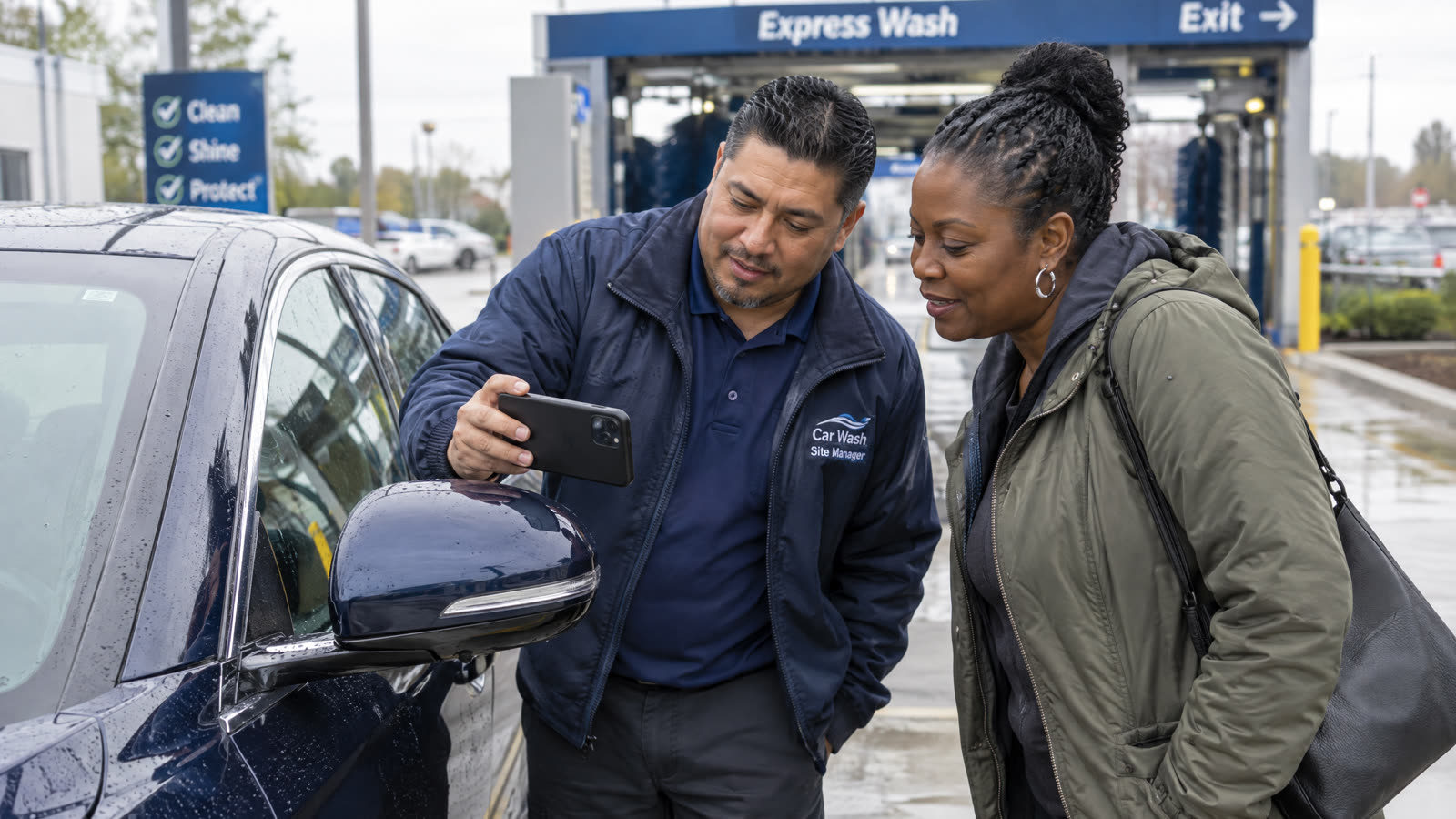
What garage keepers actually covers
Garage keepers is a commercial auto endorsement insuring physical damage to vehicles left in your care. Two other policies refuse the job: general liability excludes property in your care, custody or control, and your own auto physical damage covers only vehicles you own. The ISO endorsement's form commentary names service stations, valet parking, parking facilities and car washes.
The three bases — this is the whole thing
| Basis | Does fault have to be proved? | Who pays first |
|---|---|---|
| Legal liability — cheapest, narrowest | Yes. Pays only what you are legally obligated to pay as damages | Nobody, if you were not at fault |
| Direct coverage — excess | No | Your customer's own physical damage insurance, then yours |
| Direct coverage — primary — most expensive | No. Responds regardless of legal liability | You, before any other available insurance |
What sits underneath the basis
- A per-auto collision deductible, with a separate comprehensive and specified-causes-of-loss structure that caps the total deducted across all covered claims from one event.
- A limit that is per location, not per vehicle. The form's guidance: limits must reflect the number and value of vehicles at each location.
- Coverage for vehicles in your care — a different question from vehicles on your lot.
The thing everyone gets wrong: legal liability is not "cheaper garage keepers." It is a different promise.
The two forms carry the same name on a declarations page and produce opposite outcomes at the exit lane. A tunnel grabs an object you did not build, did not inspect and cannot control, and damage like that is arguably nobody's negligence: a fatigued mirror mount, a spoiler stuck on with tape, an antenna bought online, a lifting wrap edge. Under legal liability that whole category is a denial — the policy pays what you are legally obligated to pay, and you were not obligated. Under direct primary, it is paid.
So the question is not which is cheaper. It is: what do you say at the exit lane? If the answer is "don't worry, we'll take care of it" — and it usually is — a legal-liability form means you fund your own goodwill one car at a time, out of the margin you were protecting.
Four traps inside the form, all checkable in ten minutes:
1 · The deductible stack
One misaligned wrap brush takes the mirrors off eleven cars in twenty minutes. Without a per-event cap on the total deducted, that is eleven deductibles. Confirm the cap, and what it applies to.
2 · The limit is per location
Hail over a forty-car stack lot is one single-limit event; most washes buy a limit sized to one car. Count the maximum on your property at once, at real values.
3 · The exclusions that bite a car wash
Faulty workmanship by or on behalf of you. Defective parts or materials. Employee theft or conversion — a crime policy. Non-permanently installed sound equipment, CB radios and radar detection devices, excluded by name. Contractual liability, unless it would exist without the contract.
4 · "Was it even in your care?"
The form responds to vehicles in the insured's care. Full-service is unambiguous; express exterior is argued, though industry guidance treats a conveyor wash as having taken control. Settle it in writing before you bind.
If any of these are true, you need this endorsement — and you need to know which basis
- A customer's vehicle is on your property, moving or parked, at any point.
- Your employees drive customer vehicles on, off or through the site.
- You hold vehicles for hours, or overnight, for detailing.
- You wash fleet, dealer or municipal vehicles under a contract that mentions damage.
- You have ever said "we'll take care of it" without reading your endorsement.
By wash format
Express tunnel. Presoak, wrap brushes, arches, undercarriage spray and dryers are separate contact points on one pass, repeated all day — one fault can reach every car that follows, which makes the per-event deductible cap the first term to check. Express tunnel →
Full-service. Your employee has the keys and works inside the cabin: lost property, interior damage and driving exposures on top of the wash. No care-and-custody argument. Full-service →
Flex-serve. Both profiles at once, routinely written as if it were express. That misclassification is itself the gap. Flex-serve →
Self-serve and in-bay automatic. Unattended, and the "in your care" question is sharpest here — in a single-bay automatic every cycle is a garage keepers event with no employee in the story. Self-serve → · In-bay automatic →
Hand wash and detail. The vehicle is in your care for hours, sometimes overnight — the format where general liability alone is most often assumed to be enough. Hand wash & detail →
Edge cases worth settling before you need them
| Edge case | What happens, and what to do about it |
|---|---|
| Classic, modified and pre-1990 vehicles | Chrome trim, weatherstrip, vinyl tops and single-stage paint turn a small claim into a valuation fight. Post a vehicle-condition policy at the entrance and exclude pre-1990 and modified vehicles in writing. |
| Advanced driver-assistance systems | A knocked-out sensor, camera or radar module is a recalibration, not a part. Industry commentary, not loss data: newer vehicles are sensor-dependent and these systems can be knocked out of adjustment. No published post-wash recalibration figure exists and we will not invent one. Ask how your carrier treats calibration. |
| Electric vehicles | Same commentary: many EVs have no true neutral, and a neutral override can engage the parking brake if the vehicle sits in neutral too long — inside a moving conveyor, a real mechanical event. Unlatched charge-port doors dislodge under spray. |
| Chemical etch and staining | Garage keepers may respond, but faulty workmanship and defective materials are live defences. If a bad batch caused it, the target is your supplier's products liability — hold a certificate and an additional insured endorsement from every vendor. |
| Theft by your own employee | Not garage keepers. Expressly excluded. A crime-policy question. Cyber, crime and membership → |
| What New Jersey requires | The statutory $50,000 garage keepers minimum, plus $300,000 of garage or equivalent general liability, applies to licensed auto body repair facilities. Car washes are not subject to it, and we located no statewide car wash licensing or minimum-insurance statute. A reference point, not a rule: the body-shop floor would not cover one late-model SUV. |
How this gets placed
Standard-market package and program carriers attach it to the commercial auto part of a package where the wash is clean, the equipment modern, the loss history short and the basis requested legal liability or direct excess. Excess and surplus lines and specialty programs come in for direct primary at meaningful limits, multi-site operators, sites with a fuel island or repair operation, and accounts with a recent tunnel claim pattern.
What underwriters ask: tunnel or bay count, annual car count, conveyor and correlator type and age, brush material and replacement schedule, whether you run a posted damage-claim process, whether employees drive customer vehicles, membership count, maximum accumulation on the lot.
We publish no carrier names and no rates. No verifiable New Jersey car wash premium range exists.
On this page
The three bases · The thing everyone gets wrong · By format · Edge cases · How this gets placed · Questions
Not sure which basis you're on? Send the declarations page and the garage keepers endorsement. We'll read them and tell you in writing, whether or not you move the account.
Read next
General liability
Garage keepers covers the car. This is the one that covers the person who slipped getting out of it.
Commercial auto & HNOA
Garage keepers is damage to the vehicle. This is what the vehicle causes while your employee is driving it.
Cyber, crime & membership
Employee theft from a customer's car is expressly excluded from garage keepers. It lives here.
Garage keepers questions
Does my car wash need garage keepers if the customer never leaves the car?
Almost certainly yes: industry guidance treats even exterior-only conveyor washes as having taken control of the vehicle, and general liability excludes property in your care either way. Settle it in writing before you bind.
What's the difference between garage keepers legal liability and direct primary?
Legal liability pays only what you are legally obligated to pay as damages, so negligence has to be established. Direct primary responds regardless of fault, before any other insurance. The same broken mirror is a denial under one and a payment under the other; direct excess sits between them.
How much garage keepers limit should a car wash carry?
We will not print a number, because the answer is a calculation. The limit applies per location, not per vehicle, and must reflect the number and value of vehicles there. Count the maximum on your property at once — tunnel, stack lot, vacuums, overnight holds — value them realistically, and compare with your declarations page. Most operators find they insured one car.
If a brush knocks the mirrors off several cars in one shift, is that one claim or several?
Two things decide it: whether your form treats the event as a single occurrence, and whether a cap exists on the total deducted for all covered claims from one event. Without that cap, a per-vehicle deductible applies to every car.
Does garage keepers cover theft from a customer's car?
Not when the thief is your employee — theft and conversion by an employee is expressly excluded, and belongs on a crime policy as employee theft covering client property.
Guides
Send the declarations page and the endorsement
We'll tell you which of the three bases you are on, in writing. $0 to quote. Zero pressure. No data sold to aggregators.
Or call 908-824-6733 — Jeff picks up.
Garage keepers questions come to us from washes on the Route 17 retail strip, hand-wash lots in the urban core, salt-season operators in the northwest, Route 1 tunnels, shore washes running a summer queue and the tunnel belt in South Jersey.